

The SPOTLIGHT #1
The money is following the megawatts
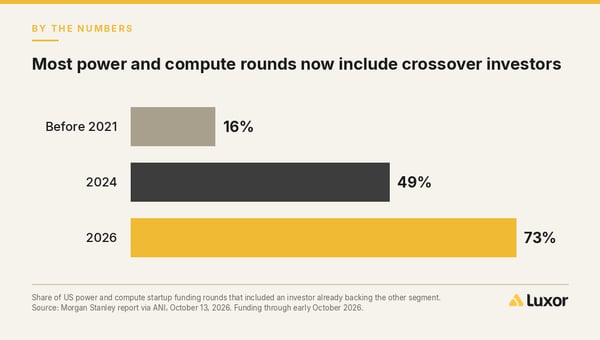
US startups tackling AI data center power and compute constraints raised $33.5 billion through early October, nearly double 2025’s total, according to Morgan Stanley. More than 80% went to new power supply or more compute per watt. The bank’s next test: capacity deployed, not capital raised.
LUXOR'S TAKE
Capital has become less scarce lately. What buyers struggle to get is capacity that is energized, cooled, and contracted to a date. Delivery schedules now matter more than funding rounds.
The SPOTLIGHT #2
A UK bank picks a smaller cloud on purpose
Starling Bank will train a transactional foundation model on 15 billion anonymized transactions using UK cloud provider Civo, aiming for production in early 2027. Its CIO framed the choice as cutting concentration risk, following a July UK government plan that flags reliance on a handful of global cloud providers.
LUXOR'S TAKE
Sovereign AI headlines usually mean government money. This is a commercial buyer choosing a smaller provider for resilience, which is a steadier source of demand than any grant program.
Around the Industry
Throughline: The cheapest new capacity is the GPUs already installed, and the software to reach them is opening up.
GPU orchestration goes open source
For site operators
NVIDIA released the full Run:ai platform as open source, including its scheduler and a tool that splits one GPU across several workloads. Operators running their own fleets get queues, quotas, and GPU sharing without building them or paying for a subscription. (NVIDIA)
A coalition of AI startups, cloud providers, and researchers launched the National Compute Grid to match idle capacity to workloads through one shared scheduler, with about 760 MW connected or in sight. (Axios)
Modal will add NVIDIA’s Arm-based Vera CPU to its agent sandbox fleet after its own tests showed up to twice the throughput under load, noting that in reinforcement learning the GPUs wait until CPU-bound rollouts finish. (Modal)
Two neoclouds take seats at the PyTorch table
Nebius and Nscale joined the PyTorch Foundation as Platinum members, and Nscale says Anyscale, creator of the Ray framework for spreading work across machines, is set to join it. (Linux Foundation)
Worth Reading

The AI chip companies that don’t want to be NVIDIA
Tenstorrent licenses its RISC-V chip designs as source code and has about $150 million in signed contracts. Tensordyne claims one-eighth the power per token of a GB200 NVL72 rack while running air cooled, but every figure is still simulation. If that holds in silicon, it favors the power-constrained, air-cooled sites miners already run.